Travis Scott, Don Toliver and Sony Music are among 11 defendants named in a copyright lawsuit over the 2019 JackBoys track “What to Do?” Israeli producer Niv Kalisky, who records as Early Yellow, filed the 52-page complaint in federal court in Manhattan on Nov. 17, 2026, alleging the song was built on his instrumental “Moazin99bpm” without a license or payment.
The case, Kalisky v. Webster, No. 1:26-cv-10094, sits in the U.S. District Court for the Southern District of New York. It also names Sheck Wes, producers Mike Dean, London Cyr and Jenius, Epic Records, Cactus Jack Records LLC, LaFlame Enterprises Inc. and London Cyr Productions Inc. The complaint demands a jury trial.
We read the full complaint. Everything below is the plaintiff’s account. None of the claims has been proven, and as of the Nov. 21 docket no defendant had filed a response.
What the complaint says happened
According to the filing, Kalisky owns the sound recording “Moazin99bpm,” which he registered with the U.S. Copyright Office on June 25, 2026, as Registration No. SR-1-071-542. The complaint says the recording was sent to a business manager for Cyr and Jenius in two zip files, and that a version of the beat later came back to him for review.
The filing then says the finished song was released on Dec. 27, 2019, by Cactus Jack Records under exclusive license to Epic Records, a division of Sony Music. It alleges the two recordings share “identical instrumental and non-vocal elements,” including chord progressions and voicings, and that the only difference is the vocal performance by Scott, Toliver and Sheck Wes.
Kalisky says he is already credited on the track. The complaint states he appears as “Produced by Earlyyellow00” in Apple Music and Spotify credits and is listed as a composer, songwriter and studio producer. His position is that a credit is not a license, and that he has never been paid for the use of the recording.
The alleged timeline
| Date | Event, as alleged | Complaint paragraph |
|---|---|---|
| May 11, 2019 | Kalisky emails “New Saudi Pack.zip,” containing the beat, to a business manager for Cyr and Jenius | 34 |
| July 4, 2019 | Second email with an “extended version” pack containing the beat | 35 |
| Oct. 30, 2019 | Cyr emails Kalisky an “Intermediate Beat” built on the sample, for review and approval | 36 |
| Dec. 27, 2019 | “What to Do?” released on all major platforms | 33 |
| Aug. 5, 2020 | First written demand to Sony Music and Epic copyright administration | 57 |
| June 19, 2025 | Israeli counsel notifies Cactus Jack via Scott’s lawyers and offers a license; no suitable response | 58 |
| June 22, 2026 | Second breach notice from current counsel, demanding an accounting and payment | 59 |
| July 6, 2026 | Third breach notice; defense counsel replies, “We are looking into this matter” | 60–61 |
| Oct. 16, 2026 | DMCA takedown notices sent to Spotify, Pandora, Apple Music, SoundCloud, Deezer, Tidal and YouTube | 63 |
| Oct. 28 – Nov. 9, 2026 | Sony and Epic file counter-notices with Apple Music, Spotify and YouTube; track reinstated | 64–65 |
| Nov. 17, 2026 | Complaint filed in S.D.N.Y. | Cover page |
The counter-notice allegation is central to the case. The complaint says Sony and Epic told the platforms the takedowns were a “mistake” or “misidentification,” and that the labels asserted their own rights in the track. Kalisky calls those counter-notices false and says they allowed the song to return to streaming services.
Eight causes of action
The complaint pleads eight counts, each against all defendants:
- Willful copyright infringement under 17 U.S.C. § 101 et seq.
- Vicarious and/or contributory copyright infringement
- Common law unfair competition by misappropriation
- Misrepresentation under the DMCA, 17 U.S.C. § 512(f)(1) and (2)
- Unjust enrichment
- Accounting
- Wrongful conversion
- Declaratory judgment
The accounting and conversion counts rest on a different theory. There, the complaint says Kalisky and the six individual defendants are co-owners of the “What to Do?” master because each contributed copyrightable material, and that the artists licensed it to the labels without accounting to him.
What Kalisky is asking for
The prayer for relief seeks a declaration that Kalisky owns 50% of all rights in the sound recording, that the defendants willfully infringed his copyright, and that they must account for all profits. It also asks for a permanent injunction against further exploitation of the track and an order restraining third-party platforms from displaying it.
On money, the complaint asks for actual damages and the defendants’ profits under 17 U.S.C. § 504(b), listing 44 income categories from streaming revenue to touring, endorsements and “equity interests in Spotify.” In the alternative, it seeks statutory damages of $150,000 for each act of infringement, plus attorneys’ fees and costs under § 505.
The filing also sets floors on three other claims: no less than $250,000 for unfair competition, $250,000 for DMCA misrepresentation and $500,000 for unjust enrichment. Those three floors add up to $1 million, the figure Rolling Stone and other outlets reported as the minimum demand. The conversion count separately asks for no less than 50% of the track’s total earnings.
The song’s numbers
The complaint says the JackBoys album debuted at No. 1 on the Billboard 200. The Billboard 200 chart dated Jan. 11, 2020 shows JackBoys as a new entry at No. 1, which matches that claim.
The filing says “What to Do?” has passed 270 million Spotify streams and 60 million YouTube plays. Those are the plaintiff’s figures, and we did not independently verify them. The complaint cites one of its exhibits, Exhibit F, which the court docket lists as a musicologist report, for the assertion that at least “sixteen similarities and identical copies of musical material” are shared between the two recordings.
Kalisky is represented by Justin M. Jacobson of Justin Jacobson Law, P.C., in New York, and Daniel Cruz Hernandez of The Royalty Law Firm PLLC. As of Nov. 21, the docket showed only the complaint with its 16 exhibits and the copyright report form, both filed Nov. 17, and no ruling on any of the allegations.
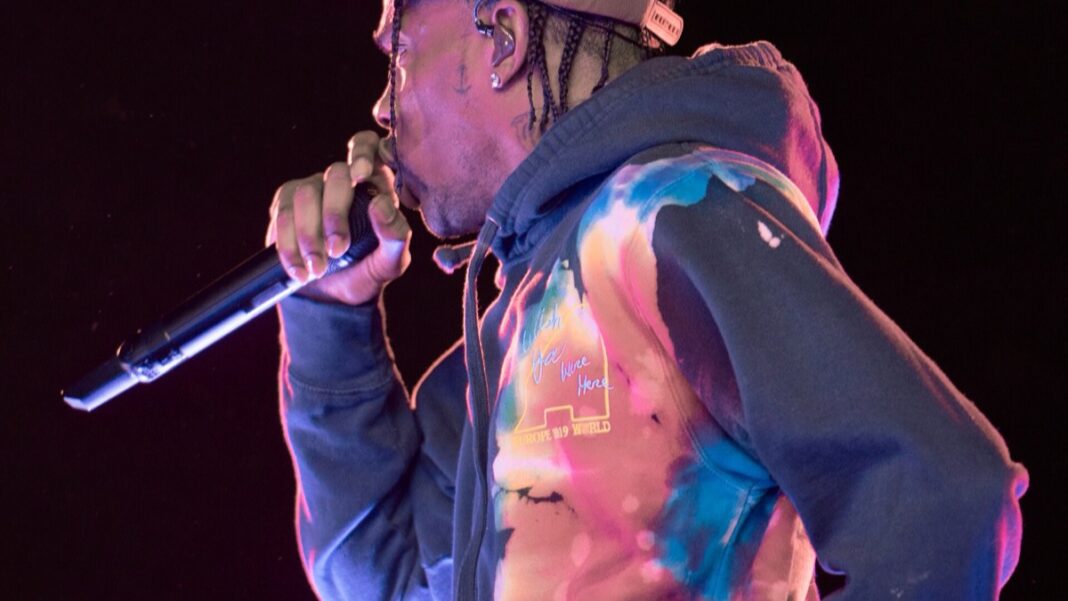
Featured image: Travis Scott performing at Openair Frauenfeld in Switzerland in July 2019 (file photo). Photo: Frank Schwichtenberg / Wikimedia Commons (CC BY-SA 4.0)

