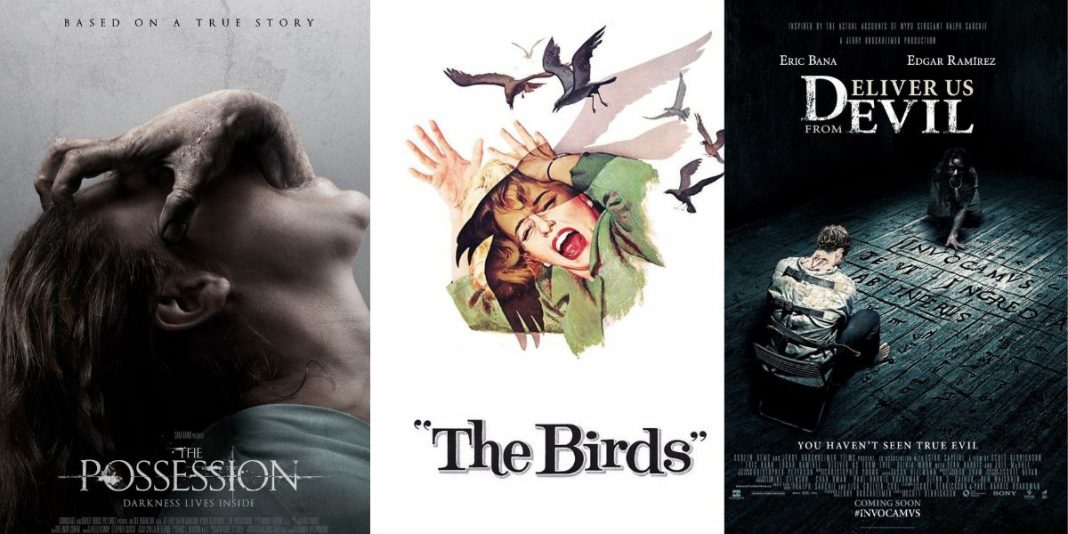
“Based on a true story” is one of horror’s oldest marketing lines, and it covers a lot of ground. Some films follow a real crime closely. Others borrow one detail from a news clipping, or retell a family’s ghost story that no one has ever proven.
This list of horror movies based on true stories sorts that out. We included horror films that the filmmakers, a festival or studio record, or reputable reporting tie to a specific real case, crime or person’s recorded claims. Films whose “true story” link we could not trace to a strong source were cut. Facts are as of October 31, 2026.
Quick guide: what each film is based on
The last column uses three plain labels. Fairly close means the film keeps the main facts of a real case. Loose means it borrows a real person or event but invents most of the plot. Claims means it dramatizes paranormal accounts that were never independently confirmed.
| Film (year) | Real story it draws on | How close |
|---|---|---|
| Psycho (1960) | Ed Gein, Plainfield, Wisconsin | Loose |
| The Exorcist (1973) | 1949 exorcism of a Maryland boy | Loose / Claims |
| The Texas Chain Saw Massacre (1974) | Ed Gein | Loose |
| Deranged (1974) | Ed Gein | Fairly close |
| The Amityville Horror (1979) | 1974 DeFeo murders; the Lutz family’s later claims | Claims (disputed) |
| The Entity (1983) | A Los Angeles woman’s 1970s attack claims, studied by UCLA researchers | Claims |
| A Nightmare on Elm Street (1984) | News reports of refugees dying in their sleep | Loose |
| Henry: Portrait of a Serial Killer (1986) | Henry Lee Lucas’s confessions | Loose |
| The Silence of the Lambs (1991) | Composite of real killers, including Gein | Loose |
| The Mothman Prophecies (2002) | 1966–67 sightings in Point Pleasant, West Virginia | Claims |
| The Exorcism of Emily Rose (2005) | Anneliese Michel’s 1976 death and the 1978 trial | Loose |
| Wolf Creek (2005) | Ivan Milat’s backpacker murders; the Peter Falconio case | Loose |
| Requiem (2006) | “Inspired by actual events” (Berlinale) | Loose |
| The Strangers (2008) | Director’s childhood; 1981 Keddie murders | Loose |
| The Haunting in Connecticut (2009) | The Snedeker family’s 1986 claims | Claims (book’s author later disowned it) |
| The Rite (2011) | Exorcist Gary Thomas, via Matt Baglio’s book | Loose |
| The Conjuring (2013) | The Perron family, Harrisville, Rhode Island | Claims |
| Deliver Us from Evil (2014) | Former NYPD Sgt. Ralph Sarchie’s book | Claims |
| Winchester (2018) | Sarah Winchester and her San Jose mansion | Loose (legend) |
| Things Heard & Seen (2021) | 1982 murder of Cathleen Krauseneck | Loose |
| The Deliverance (2024) | The Ammons family, Gary, Indiana, 2011 | Claims |
| The Conjuring: Last Rites (2025) | The Smurl family, West Pittston, Pennsylvania | Claims |
Real crimes and real killers
The darkest entries on the list start with Ed Gein. In 1957, police searching his farm in Plainfield, Wisconsin, found the body of hardware store owner Bernice Worden and other human remains, Biography reports. He admitted killing Worden and tavern owner Mary Hogan and was found legally insane.
Psycho (1960)
Alfred Hitchcock’s film came from Robert Bloch’s novel. Norman Bates was not a direct copy of Gein, but Bloch was writing near where Gein lived and was struck by how closely his character resembled him, according to Biography.
The Texas Chain Saw Massacre (1974) and Deranged (1974)
Tobe Hooper’s film is only loosely tied to Gein. Its killer family has no relation to him, though Leatherface’s masks echo his obsession with human skin. Hooper called Gein “like a real boogeyman,” TIME reported.
The lesser-known Deranged, from Jeff Gillen and Alan Ormsby, stays nearer the facts. Its farmer, Ezra Cobb, turns to grave robbing after his mother dies. TIME calls it one of the more accurate fictional versions of Gein’s story.
The Silence of the Lambs (1991)
Jonathan Demme’s thriller gave its killer, Buffalo Bill, traits taken from several real murderers. TIME has reported the character drew on six killers, including Gein and Ted Bundy, while FBI profiler John Douglas has named Gein as one of three.
Henry: Portrait of a Serial Killer (1986)
John McNaughton’s film premiered in Chicago in April 1986 but did not open in New York until March 23, 1990, the AFI Catalog shows. The filmmakers were inspired by Henry Lee Lucas’s confessions on a national TV show.
Those confessions are shaky ground. Lucas claimed hundreds of murders, but Biography notes there was no proof beyond three known victims. He died in a Texas prison on March 12, 2001.
Wolf Creek (2005)
Australia’s outback horror film is a blend of crimes, not one case. Director Greg McLean told ABC News it drew on several true-crime stories, including Ivan Milat’s backpacker murders, and only partly on the Peter Falconio case.
The Falconio link still mattered. The Northern Territory’s chief justice blocked the film there during Bradley John Murdoch’s trial over fair-trial concerns. Falconio was killed near Barrow Creek on July 14, 2001; Murdoch was convicted in 2005 and died in 2025, and the body has never been found, ABC reported in July 2026.
The Strangers (2008)
Bryan Bertino’s home-invasion film grew from his own childhood, when a stranger knocked on his door asking for someone who was not there. TIME also links it to the unsolved 1981 Keddie murders in California.
Things Heard & Seen (2021)
Netflix’s film, directed by Shari Springer Berman and Robert Pulcini, adapts Elizabeth Brundage’s 2016 novel All Things Cease to Appear. The book was partly inspired by the 1982 ax murder of Cathleen Krauseneck, TIME reported, along with ghostly stories from Brundage’s own home.
The real case moved on after the film. A Monroe County jury convicted her husband, James Krauseneck, of second-degree murder in September 2022, WXXI News reported. He died in prison in May 2023, and under New York law his conviction was vacated, WXXI added.
Exorcism and possession cases
Possession films sit in a gray zone. The rituals and court cases behind them are documented, but whether anything supernatural happened is a matter of belief.
The Exorcist (1973)
William Friedkin’s film adapts William Peter Blatty’s novel, which drew on a 1949 exorcism of a 14-year-old Maryland boy that Blatty learned about while at Georgetown, according to the AFI Catalog. The film opened in New York and Los Angeles on December 26, 1973.
The case itself is contested. Writer Mark Opsasnick’s 1999 investigation concluded the boy was “probably troubled, not possessed,” History.com reports.
The Exorcism of Emily Rose (2005) and Requiem (2006)
Scott Derrickson’s courtroom horror film is loosely based on Anneliese Michel, a German student who died at 23 after months of exorcism rites, TIME notes. NPR’s review named stars Laura Linney and Tom Wilkinson.
The record behind it is grim. A neurologist had diagnosed Michel with epilepsy, and her autopsy listed “malnutrition and dehydration,” TIME reported in 1976. In 1978, a court in Aschaffenburg found two priests and her parents guilty of negligent homicide, giving each a six-month suspended sentence, TIME reported.
Germany’s Requiem, directed by Hans-Christian Schmid, tells a similar story of an epileptic Catholic student in the early 1970s who agrees to an exorcism. The Berlinale lists it as “inspired by actual events” without naming the case. Sandra Hüller won the festival’s Silver Bear for Best Actress for the lead role.
The Rite (2011)
Mikael Håfström’s film, starring Anthony Hopkins and Colin O’Donoghue, adapts Matt Baglio’s nonfiction book about real-life exorcist Gary Thomas, NPR noted. Thomas was an American priest sent to Rome to train as an exorcist, TIME reported in 2009. The film’s lead, Michael Kovak, is a fictional character.
Deliver Us from Evil (2014)
Derrickson returned to the subject with this police thriller starring Eric Bana. It comes from a book by former NYPD Sgt. Ralph Sarchie, who reportedly came to believe some criminals he faced were possessed, NPR reported. The film is based on his account, not on proven events.
The Deliverance (2024)
Lee Daniels’ Netflix film dramatizes the alleged 2011 haunting of the Ammons family in Gary, Indiana. Police and Indiana child welfare officials became involved in the real case. TIME reported the film takes significant liberties with the facts, including moving the ritual from a church to the family home. It streamed on Netflix from August 30, 2024.
Haunted houses and the Warren files
Many of the best-known “true” hauntings trace back to the families who lived in the houses, and often to paranormal investigators Ed and Lorraine Warren. Their accounts drew large audiences and steady skepticism.
The Amityville Horror (1979)
The crime was real. On November 13, 1974, Ronald DeFeo Jr. killed six members of his family in their Amityville, New York, home, Biography reports. George and Kathy Lutz later bought the house and left on January 14, 1976, after 28 days.
Their account of what happened there is disputed. Stuart Rosenberg’s film adapts Jay Anson’s 1977 book and ends with a note that events were changed for drama, according to the AFI Catalog. The Lutzes’ former lawyer, William Weber, later said they invented the story “over many bottles of wine,” Biography reports.
The Entity (1983)
Sidney J. Furie’s film, often dated 1982, opened in the U.S. on February 4, 1983, per the AFI Catalog. It adapts Frank De Felitta’s 1978 novel, a fictionalized account of a Los Angeles woman’s claims of attacks by an unseen force, which two UCLA parapsychology researchers investigated.
The case is getting a second film. What Happened to Doris?, directed by Nick Simon and starring Heather Graham, is listed as a 2026 title, but as of October 31, 2026, its Rotten Tomatoes page gives no wide release date.
The Haunting in Connecticut (2009)
Peter Cornwell’s film is sold as “based on a chilling true story,” per its Apple TV listing. It draws on the Snedeker family’s claims about a rented Connecticut house in 1986, which the Warrens publicized. Ray Garton, who wrote the 1992 book on the case, later admitted the story was not true, History.com reports.
The Conjuring (2013)
James Wan’s hit is based on the Perron family’s claims after moving into a farmhouse in Harrisville, Rhode Island, in 1971, with the Warrens brought in as investigators, TIME reported. That makes it a film about the Warrens’ version of events, not proven ones.
The franchise kept mining the Warrens’ files. History.com points to their investigation of the Enfield poltergeist near London in the late 1970s, and to a reportedly haunted doll that inspired the Annabelle films.
The Conjuring: Last Rites (2025)
The newest entry on this list opened on September 5, 2025, and had grossed $499.3 million worldwide as of Oct. 31, 2026, per Box Office Mojo. Director Michael Chaves has made three of the series’ nine films, NPR reported.
It centers on Jack and Janet Smurl, who moved into a double-block home at 330 Chase Street in West Pittston, Pennsylvania, in August 1973. The Warrens took the case in 1986, and the family moved out in 1988. The film is set in a fictional version of the town, Biography reports.
Winchester (2018)
Helen Mirren plays Sarah Winchester, heir to the rifle fortune, in this film from brothers Michael and Peter Spierig. Winchester built and rebuilt her San Jose mansion from the 1880s until her death in 1922, NPR reported.
The ghost story is the shaky part. The legend says a medium told her to keep building. Historian Mary Jo Ignoffo’s 2010 biography found she stopped construction at times, and Biography notes the film played up the supernatural side.
Strange news stories turned into horror
Two entries started not with a crime or a family’s claims, but with odd news stories that filmmakers turned into nightmares.
A Nightmare on Elm Street (1984)
Wes Craven said the idea came from a Los Angeles Times story about a refugee from the Cambodian genocide who died in his sleep. The wider wave of such deaths mostly struck Hmong refugees from Laos and was later called Sudden Unexplained Nocturnal Death Syndrome (SUNDS), History.com reports.
The Mothman Prophecies (2002)
Mark Pellington’s film, starring Richard Gere, is set in Point Pleasant, West Virginia, per the Austin Chronicle. The film is based on John Keel’s account, first published in 1975, of sightings that began in November 1966 and totaled 26 over one year, according to e-WV, the West Virginia encyclopedia.
One part is undeniably real. The Silver Bridge collapsed on December 15, 1967, and 46 people died, History.com reports. Any link between the sightings and the disaster is folklore.
Popular picks we left off
Several films often called “true stories” did not make the cut. For Child’s Play, Jennifer’s Body, Poltergeist, The Possession, The Toolbox Murders and The Witch, we could not confirm a specific real case from the filmmakers or a major outlet, or the claimed source story itself was in doubt.
That is the pattern across this genre. A real crime or a real family may sit at the start, but the scares on screen are almost always invented, so the table above is the quickest way to tell which is which.

