Three Tribune Publishing newspapers sued Brave Software, Inc. in Manhattan federal court on Nov. 2, 2026, accusing the browser and search company of copying their journalism and reselling it to AI companies. The New York Times filed its own suit against Brave the same day, and the two complaints make closely matching claims.
The Tribune case was brought by Daily News, LP, Chicago Tribune Company, LLC and Orlando Sentinel Communications Company, LLC. Filed as No. 1:26-cv-09554 in the Southern District of New York, the 69-page complaint names Brave as the only defendant and asks for a jury trial. None of the claims has been proven in court.
Three Brave products are in the complaint
The papers describe Brave’s search index as the root of the problem, then name three products that use it or sit beside it.
The first is Ask Brave, the AI answer tool inside Brave Search. The complaint says Brave launched an AI feature called “Summarizer” in 2023, then updated and renamed it Ask Brave in 2025. It alleges the tool feeds pages from Brave’s index to an AI model whose answers “often” include verbatim text or detailed summaries.
The second is the Brave Search API, which the complaint says other AI companies pay to use for training and for grounding answers in live web content. It names Anthropic, Perplexity, Mistral, xAI and Cohere as customers, citing Brave’s own web pages and blog posts. Those companies are not defendants.
The third is the Brave Browser. The papers say it has a setting called “Paywall blocker,” which they allege lets users read subscriber-only articles without logging in. They also object to the browser’s default ad blocking and to Brave News, a built-in news feed that lists the Chicago Tribune among its sources.
What the papers say their tests showed
Much of the complaint is screenshots from tests the publishers say they ran. In one, Ask Brave was asked to list that day’s New York Daily News articles. According to the filing, it listed 35 titles and offered to “fetch the complete version” of any of them.
The examples below are taken from the complaint’s own descriptions. The word counts are the publishers’ figures, not ours.
| Brave product | Article tested | Paper | What the complaint says came back |
|---|---|---|---|
| Ask Brave | Central Park horse carriage ban deal | Daily News | Nearly 600 words |
| Ask Brave | Tax breaks for data centers near O’Hare | Chicago Tribune | Over 1,200 words |
| Ask Brave | Police report on an alleged assault near the University of Chicago | Chicago Tribune | More than 1,000 words |
| API, LLM Context | Florida Amendment 3 and local school taxes | Orlando Sentinel | The entire article text |
| API, News Search | Taxi Workers Alliance health benefits call | Daily News | Nearly 350 words, verbatim |
| API, News Search | Chicago zoning and housing report | Chicago Tribune | More than 250 words, verbatim |
The news reports we reviewed led with the Ask Brave examples. The API results are a separate strand of the case, because the complaint argues that what developers receive from Brave can stand in for the article itself. It quotes Brave’s documentation describing the LLM Context endpoint as giving AI tools page content “without need for further scraping.”
Five legal claims and the relief sought
The Brave copyright lawsuit from the Tribune papers lists five counts: direct, contributory and vicarious copyright infringement; a violation of the Digital Millennium Copyright Act’s ban on getting around access controls; and unjust enrichment under New York law.
The DMCA count centers on the paywall setting. The unjust enrichment count stands apart from the copying claims. The complaint says it “does not depend on any copying” and rests only on Brave allegedly removing the papers’ ads and showing its own, through its Brave Ads program.
The papers ask for statutory damages, actual damages, restitution of profits, a permanent injunction, and their costs and attorneys’ fees. The complaint does not name a dollar figure. It does allege that Brave “has made more than $100 million” from publishers’ work, while the publishers received nothing.
The size of the catalog at stake comes from the papers’ own registration counts.
| Plaintiff | Registered newspaper issues | Articles in those issues |
|---|---|---|
| Daily News, LP | Over 9,000 | Over 500,000 |
| Chicago Tribune Company, LLC | Over 15,000 | Over 1.2 million |
| Orlando Sentinel Communications Company, LLC | Over 8,500 | Over 400,000 |
Those three article figures add up to more than 2.1 million, which fits the complaint’s own total of “over 2 million articles” in its registered issues.
The Times files a near-twin complaint
The New York Times complaint, posted by the company, is stamped Case 1:26-cv-09549 and runs 72 pages. Both suits were filed by the same law firm, Rothwell, Figg, Ernst & Manbeck, and they bring the same five counts against the same three Brave products.
The texts overlap heavily. We split each complaint into overlapping eight-word sequences and checked how many of the Tribune complaint’s sequences also appear in the Times filing. About 59 percent do, word for word.
The differences are in the evidence. The Times says it sent cease-and-desist letters to Brave CEO Brendan Eich on Aug. 11, 2025, and April 13, 2026, and that Brave ignored both. It says the Times owns more than 10 million registered works.
The Times also cites its own tests. In one, it says the API’s LLM Context endpoint returned 1,291 of the 1,295 words in a Times article. In another, it says Ask Brave produced about 87 percent of a paywalled article while saying the rest was behind the paywall.
What Brave has said so far
Brave did not immediately respond to requests for comment from TechCrunch and TheWrap on Nov. 2. As of Nov. 3, Brave’s blog feed showed no post about either suit.
Both complaints say Brave never disclosed the name of its crawler, so sites cannot block it. Brave has published its reasoning on that point. Its help page on its crawler says it “does not advertise a differentiated user agent” to avoid being shut out by sites that only allow Google. It says it will not crawl pages Googlebot cannot crawl.
Brave is also in a related fight in California. It filed a declaratory judgment action against News Corp and four related companies, including Dow Jones and NYP Holdings, in federal court in Oakland on May 19, 2026. The News Corp side filed an answer on July 21, with counterclaims by Dow Jones and NYP Holdings.
Steven Lieberman, the lawyer whose signature appears on both New York complaints, put the Tribune papers’ view this way in a statement quoted by TheWrap: “Buying stolen goods secondhand doesn’t make them legitimate.”
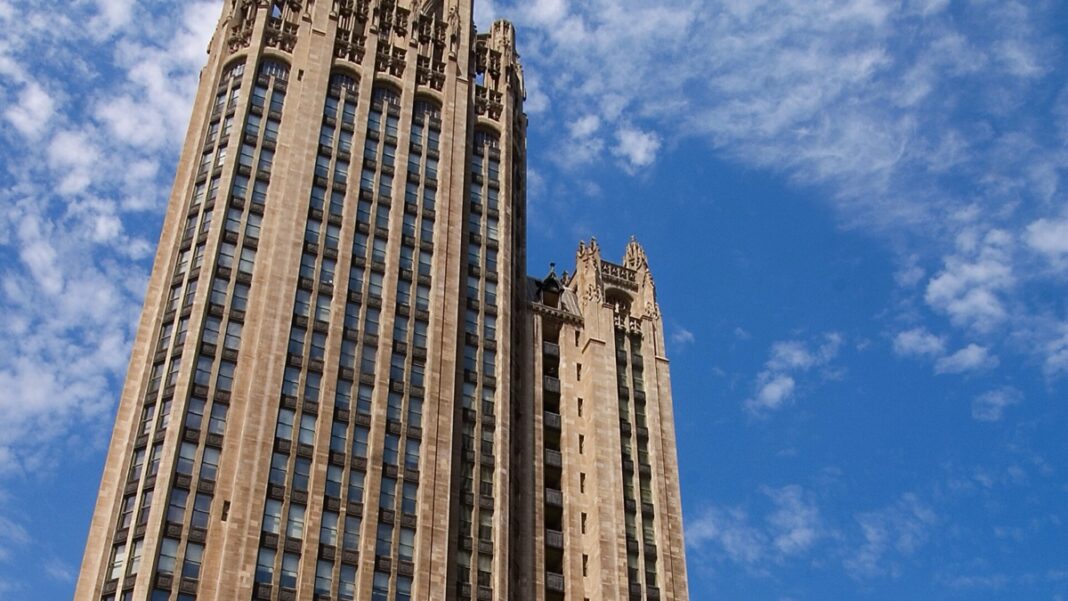
Featured image: Tribune Tower in Chicago, the Chicago Tribune’s former home. Photo: Stuart Seeger / Wikimedia Commons (CC BY 2.0)

